
Humidity Swings and Hardwood in CT/NY
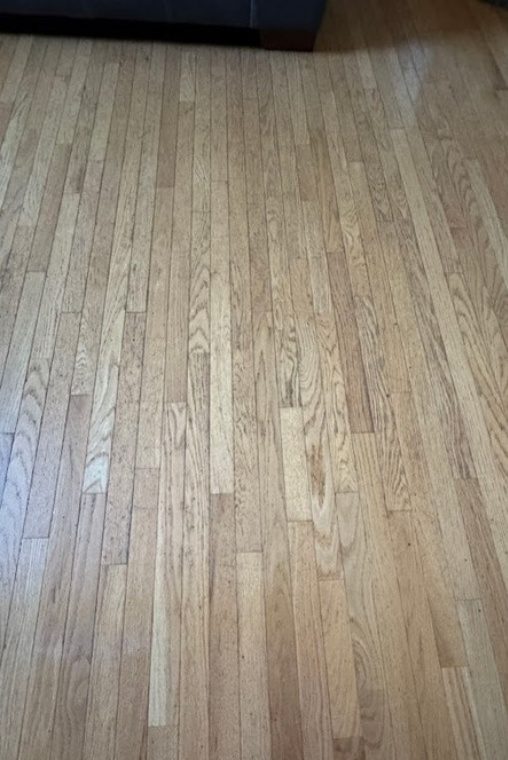
Late August in Fairfield County and lower Westchester is still damp. September is not. Outdoor humidity drops, the AC goes off, the heat comes on, and indoor air can swing from sticky to dry in two or three weeks. Hardwood feels that swing before you do.
This is not a new floor failing. It is wood doing what wood does between the last humid week and the first dry one. Here is what that looks like, and what is worth watching.
What the late-summer damp does
Through July and August, indoor air in Stamford, Greenwich, and Rye often sits well above 50% relative humidity, especially in older houses without tight AC. Solid hardwood and many site-finished floors take on a little moisture and swell. You may notice:
- Boards that look tighter than they did in March
- A slight crown or cup if a room stayed humid and the AC ran hard
- Doors or transitions that rub a little at the floor
A little swell in August is normal. Wet-mopping or a leaking slider makes it worse. Steam and vinegar still do not belong on these floors.
What the early-fall dry does
When nights cool off and the furnace or heat pump starts, indoor humidity can fall into the 20s if nobody is watching it. The same boards that were tight in August lose moisture and shrink. Common signs:
- Hairline gaps that were gone all summer
- A board that sounded solid in July and sounds a little hollow near a vent
- Finish that looks a bit duller once the sun angle changes
Small seasonal gaps are not a refinish. Filling them in September often looks worse in June, when the wood swells again and the filler ridges up.
What to watch in the next few weeks
The swing, not a single reading, is the problem. A cheap hygrometer in the driest room (often the first floor near a vent) tells you more than guessing.
- If indoor humidity stays roughly 35–45%, the floor is in the range most solid hardwood wants.
- If it stays above about 55% after the heat is on, look for a damp basement, a closed-up AC drain, or a room that never dries. Cupping from leftover summer moisture is the risk, not winter gaps.
- If it drops under 30% once heat is on, turn on the humidifier (or a room unit) before the gaps get wide. Do not wet-mop to put water back. That swells the top of the board.
Watch walkways and the first three feet in front of sliders. That is where leftover summer moisture and the first blast of heat both show up.
Care during the swing
For most homes in Darien, New Canaan, Norwalk, Westport, White Plains, and Rye, this is a watch-and-clean month, not a sand-the-house month:
- Dry dust, then a hardwood-safe cleaner. No steam.
- Keep felt on chairs before fall traffic picks up.
- If you have a whole-house humidifier, this is the week to turn it on and actually set it.
- If a board is cupped from a summer leak, let the house dry and stabilize before anyone sands it. Sanding a wet crown leaves a dip in January.
When it is more than weather
Call us if the movement is not even, or if the finish is gone:
- One room cupped and the next room fine (often a leak, a wet crawl, or an AC issue)
- Raw wood showing in traffic paths
- Pet scratches that catch a sock
- A color or stain you want changed and you can be off the floors for the job window
If the only change is summer tightness turning into fall gaps, wait. Refinishing does not stop seasonal movement. A floor sanded in a still-damp September can look different after the first dry week of heat.
CT / NY houses do not all swing the same
A 1920s colonial in Greenwich with radiators dries slower than a 1960s Stamford split with forced air. Heat pumps in newer New Canaan builds can keep humidity more even, or they can dry a room fast if the setpoint is aggressive. We would rather walk it and tell you to wait than guess from a photo of a gap that will close in May.
The Hardwood Guys. Fairfield County, CT and Westchester, NY. Call (203) 290-1510.